
What is a Belt Conveyor System?
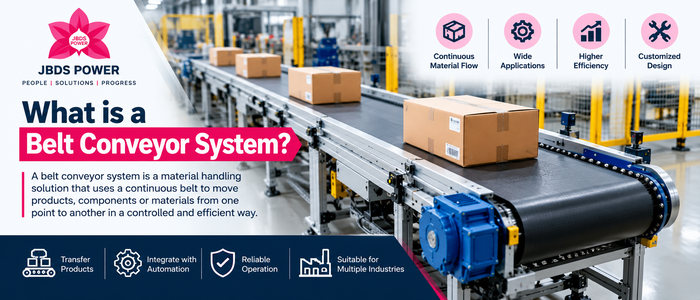
A Belt Conveyor System is a material-handling system that uses a continuous belt running over pulleys and supporting rollers or a suitable bed to transport materials from one point to another.
The belt forms the main carrying surface. A drive arrangement powers the belt, while the supporting structure maintains its path and stability during operation.
Depending on the application, belt conveyors can transport:
• Boxes and cartons
• Industrial components
• Packaged products
• Bags and containers
• Automotive parts
• Assembly components
• Raw materials
• Finished products
• Lightweight and medium-duty industrial loads
The conveyor can be engineered according to the material being transported and the surrounding manufacturing process.
For industrial customers, this means the conveyor does not have to be a standard fixed product. Its length, width, belt material, height, speed, loading arrangement, discharge arrangement and automation controls can be selected according to the application.
How Does a Belt Conveyor System Work?
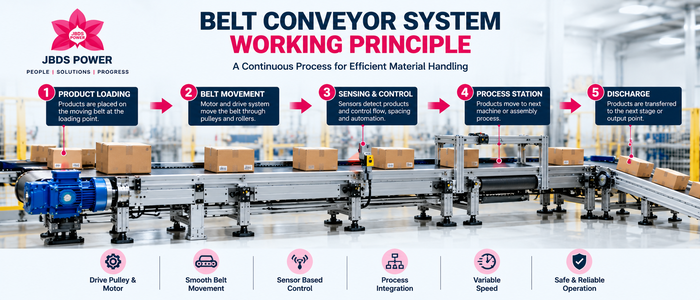
A belt conveyor works through a continuous movement cycle.
An electric motor and drive system rotate the drive pulley. The drive pulley moves the conveyor belt, while other pulleys and supporting rollers guide the belt through the required conveyor path.
Products are placed onto the moving belt at the loading point and transported toward the discharge point or next production stage.
A typical material-flow sequence can be represented as:
PRODUCT LOADING → BELT MOVEMENT → CONTROLLED TRANSFER → PROCESS STATION → DISCHARGE
Depending on the application, sensors and automation controls can be added to detect products, start or stop movement, control spacing, synchronize operations and communicate with upstream or downstream equipment.
For more advanced applications, the conveyor can become part of a larger automated production system rather than operating as a standalone material-handling machine.
Main Components of an Industrial Belt Conveyor
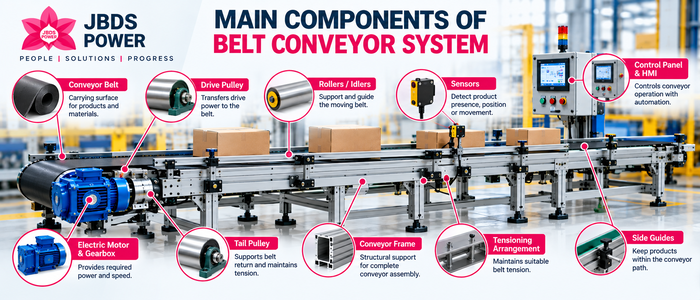
The design of a belt conveyor varies according to its application, but an industrial system generally combines several important components.
• Conveyor Belt – Provides the carrying surface for the product or material.
• Drive Pulley – Transfers drive power to the conveyor belt.
• Tail Pulley – Supports belt return and helps maintain the conveyor path.
• Electric Motor & Gearbox – Provide the required power and operating speed.
• Rollers / Idlers – Support and guide the moving belt.
• Conveyor Frame – Provides structural support for the complete conveyor assembly.
• Tensioning Arrangement – Helps maintain suitable belt tension.
• Side Guides – Help keep products within the required conveyor path.
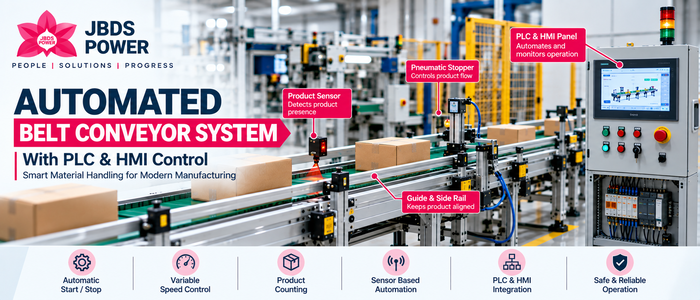
• Sensors – Can detect product presence, position or movement.
• Control Panel – Controls conveyor operation and can interface with other equipment.
• PLC & HMI – Can be incorporated where automated sequence control and operator interaction are required.
The final configuration should always be based on actual load, product and process requirements rather than selecting components independently.
Types of Belt Conveyor Systems
Belt conveyors can be configured in several ways depending on the movement path and manufacturing requirement.
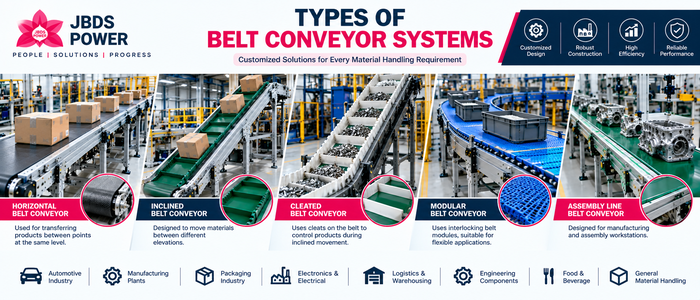
• Horizontal Belt Conveyor – Used for transferring products between points at approximately the same level.
• Inclined Belt Conveyor – Designed to move products between different elevations.
• Declined Belt Conveyor – Transfers products from a higher level to a lower level.
• Cleated Belt Conveyor – Uses cleats on the belt to help control products during inclined movement.
• Flat Belt Conveyor – A common configuration for boxes, components and general production-line movement.
• Modular Belt Conveyor – Uses interlocking belt modules and can be useful where specific operating or maintenance requirements favor a modular construction.
• Assembly Line Belt Conveyor – Designed around manufacturing and assembly workstations.
• Automated Belt Conveyor – Integrated with sensors, PLC, HMI and other automation systems.
The correct configuration depends on the product, available floor space, transfer height and required production flow.
Horizontal Belt Conveyor Systems
A Horizontal Belt Conveyor transfers products along a generally level path and is one of the most common conveyor configurations used in industrial facilities.
It can be used between manufacturing stations, assembly processes, inspection areas, packaging machines and warehouse handling points.
Horizontal conveyors can be particularly useful where a continuous flow of similar components or packages needs to be maintained across a production area.
JBDS Power can customize conveyor dimensions, speed, frame construction, belt selection and controls according to the process requirement.
Inclined Belt Conveyor Systems
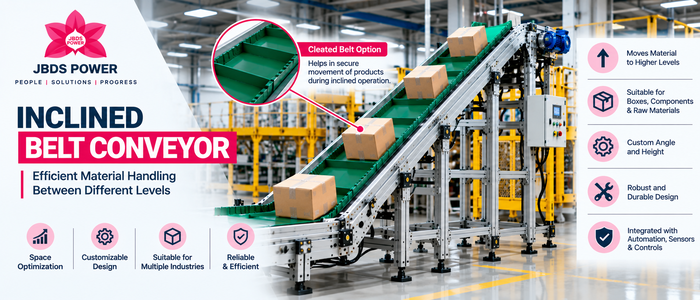
An Inclined Belt Conveyor is designed to move materials between different heights.
It can be useful when material needs to move from floor level to an elevated workstation, between different production levels or from one machine to another where their loading heights differ.
Depending on the product and angle, suitable belt surfaces, cleats and side guides can be incorporated to improve product stability during movement.
Inclined conveyor engineering should consider product weight, conveyor angle, belt selection, speed and loading characteristics.
Automated Belt Conveyor Systems with PLC & HMI
Modern manufacturing plants increasingly require conveyors to communicate with machines and production controls.
A PLC-controlled belt conveyor system can be integrated with sensors, HMI interfaces, drives and safety controls to create a more automated material-flow process.
Depending on project requirements, automation can provide:
• Automatic Start / Stop
• Product Detection
• Variable Speed Control
• Product Counting
• Position Detection
• Machine Interlocking
• Conveyor Sequencing
• Alarm Indication
• Emergency Stop Integration
• Production-Line Synchronization
• HMI-Based Operator Control
JBDS Power's existing conveyor solutions include PLC and HMI automation integration as part of customized conveyor engineering. JBDS Power
Applications of Belt Conveyor Systems
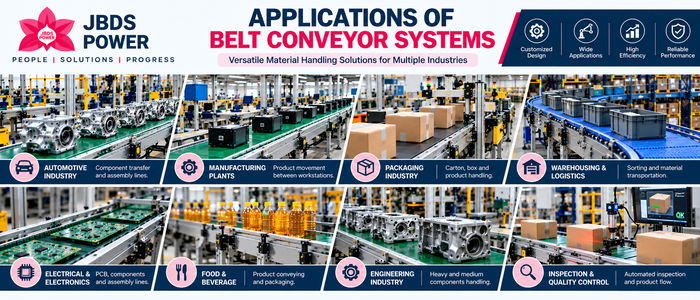
Belt conveyors are used across a broad range of manufacturing and material-handling operations because the conveyor can be adapted around different products and layouts.
Typical applications include:
• Manufacturing Plants
• Automotive Component Production
• Assembly Lines
• Packaging Lines
• Warehouses
• Logistics Operations
• Electrical & Electronics Manufacturing
• Food and Packaging Processes where suitable conveyor materials are specified
• Engineering Component Manufacturing
• Inspection Lines
• Sorting Operations
• Loading & Unloading Processes
• Industrial Production Lines
JBDS Power's broader customized conveyor portfolio is positioned for manufacturing plants, assembly lines, warehouses, packaging units and industrial automation projects. JBDS Power
Benefits of Using Belt Conveyor Systems
A properly designed industrial belt conveyor can improve material movement and help create a more organized manufacturing process.
Key potential benefits include:
• Continuous Material Flow – Products can move consistently between process stages.
• Reduced Manual Handling – Repetitive manual transportation can be reduced.
• Improved Productivity – Material can reach the next workstation more efficiently.
• Controlled Product Movement – Speed and transfer sequence can be engineered around the production process.
• Better Space Utilization – Conveyor routing can be planned around the available factory layout.
• Automation Integration – Sensors, PLC, HMI and other controls can be incorporated.
• Reduced Handling Time – Continuous transportation can reduce waiting between operations.
• Scalable Design – Customized conveyor systems can be developed with future production requirements in consideration.
The actual benefit depends on conveyor design, operating conditions and how effectively the system is integrated with the overall manufacturing process.
Belt Conveyor System vs Manual Material Handling
Manual movement can remain practical for low-volume or highly variable processes, but repetitive material transfer can consume operator time and create inconsistencies in production flow.
A belt conveyor provides a defined material path and repeatable movement between process points.
For suitable applications, conveyor automation can reduce repetitive handling, improve material-flow consistency and make production planning more predictable.
The decision between manual handling and conveyor automation should therefore consider production quantity, transfer distance, component weight, cycle time, available space and investment requirements.
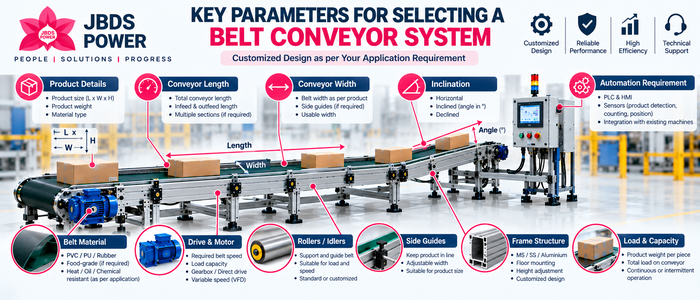
How to Select the Right Belt Conveyor System
Selecting a belt conveyor should not begin only with conveyor length and width.
The complete application needs to be evaluated.
Important parameters include:
• Product dimensions
• Product weight
• Material or product type
• Required conveyor length
• Required conveyor width
• Loading and discharge height
• Horizontal or inclined movement
• Required belt speed
• Production rate
• Belt material
• Environmental conditions
• Available plant space
• Automation requirement
• Sensor requirement
• Integration with existing machines
• Safety requirements
For example, an assembly-line conveyor carrying lightweight components has very different engineering requirements from an inclined conveyor transferring heavier industrial products.
This is why a customized belt conveyor system should be designed around the actual production process.
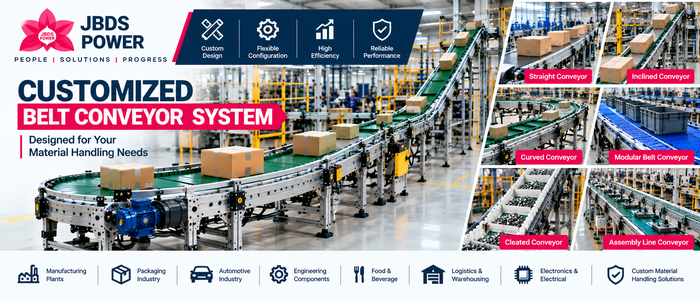
Customized Belt Conveyor Systems by JBDS Power
Every factory layout and production process is different.
JBDS Power provides customized conveyor systems and industrial automation solutions developed around customer-specific requirements rather than limiting the project to a standard conveyor configuration.
The engineering scope can include:
• Requirement Analysis
• Plant Layout Study
• Customized Conveyor Design
• Mechanical Engineering
• Conveyor Manufacturing & Fabrication
• Motor & Drive Selection
• Sensor Integration
• PLC Programming
• HMI Integration
• Electrical Control Panel
• Production-Line Integration
• Installation & Commissioning
• Testing & Validation
• Technical Support
JBDS Power's published conveyor process covers requirement analysis, design and engineering, manufacturing and fabrication, automation/control integration, installation, commissioning, testing and after-sales support. JBDS Power
Why Choose JBDS Power for Belt Conveyor Systems?
JBDS Power combines conveyor engineering with broader industrial automation and customized manufacturing capabilities.
Rather than treating the conveyor only as a mechanical structure, the complete requirement can be evaluated from a production and automation perspective.
JBDS Power's conveyor capabilities include customized design, in-house manufacturing, industrial automation, PLC & HMI integration, installation support and technical support. The company also works across industrial automation, customized machinery and engineering projects. JBDS Power
For customers developing a new production line or improving an existing material-handling process, this allows the conveyor to be designed as part of the overall manufacturing system.
Frequently Asked Questions About Belt Conveyor Systems
What is a belt conveyor system?
A belt conveyor is a material-handling system that uses a continuously moving belt to transfer products or materials between different locations or process stages.
Where are belt conveyors used?
They are commonly used in manufacturing, assembly, packaging, warehousing, logistics and industrial material-handling applications.
Can belt conveyor dimensions be customized?
Yes. Conveyor length, width, height and other design parameters can be engineered according to product and plant requirements.
Can belt conveyor speed be controlled?
Yes. Depending on the drive and control configuration, variable-speed operation can be incorporated.
Can a belt conveyor be integrated with PLC and HMI?
Yes. Sensors, PLCs, HMIs and other industrial automation equipment can be integrated according to the process requirement.
Can JBDS Power manufacture customized belt conveyors?
JBDS Power currently offers customized conveyor design and manufacturing, including belt conveyors and automation integration. JBDS Power
What information is needed for a belt conveyor quotation?
Useful information includes product dimensions and weight, conveyor length and width, required height, production rate, operating environment, belt preference and automation requirements.
Looking for a Customized Belt Conveyor System?
If your manufacturing plant requires a new Belt Conveyor System, production-line conveyor or customized material-handling solution, JBDS Power can evaluate the application and develop the conveyor around your process requirements.
Share your product dimensions, product weight, conveyor length, required width, transfer height, target speed or production rate, plant layout and automation requirements with the JBDS Power engineering team.
JBDS POWER GROUP
Plot No. 302, Sector 7, IMT Manesar, Gurgaon, Haryana – 122052
Phone: +91 7290054361
Email: digital@jbdspower.com
Email: info@jbdspower.com
The above contact details match the company's current Contact page. JBDS Power