

What is a Bollard System?
A bollard system is a physical access-control and perimeter-protection solution designed to manage vehicle movement and help protect restricted or sensitive areas.
Depending on the application, bollards can be permanently fixed, removable, manually operated or automatically raised and lowered. They are commonly used at industrial facilities, commercial premises, parking areas, corporate campuses, infrastructure projects and controlled entry points.
Modern bollard systems can also be integrated with access control, RFID, boom barriers, security systems and automation controls to create a complete vehicle-entry management solution.
Why Are Bollards Used?
Facilities often need to allow authorized vehicles to enter while preventing unauthorized vehicle movement.
Bollards create a clearly defined physical barrier while allowing pedestrian movement and controlled vehicle access.
Some common purposes include:
Vehicle access management
Restricted-area protection
Perimeter security
Parking management
Traffic-flow control
Protection of entrances and infrastructure
Separation of pedestrian and vehicle zones
Controlled access to industrial facilities
The correct bollard depends heavily on the risk level and operating requirement of the site.
Types of Bollard Systems
Fixed bollards are permanently installed at a designated location.
They are suitable where vehicle access needs to remain restricted continuously.
Common applications: building entrances, pedestrian areas, industrial boundaries, utility areas and restricted zones.

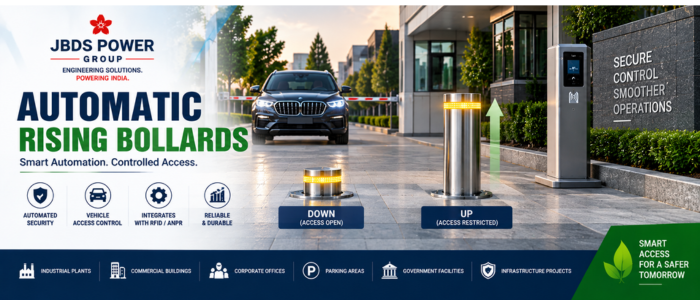
Automatic bollards remain below or near ground level when access is permitted and rise to restrict vehicle movement when required.
They can be operated through systems such as:
Remote Control → RFID → Access Control → Security Cabin → PLC/Controller
These are particularly useful where frequent controlled vehicle movement is required.
Typical locations include corporate campuses, industrial plants, premium properties, government facilities and secured entrances.
3. Removable Bollards
Removable bollards provide more flexibility.
They can be installed when an area needs to be restricted and removed when vehicle access is required.
These are useful where access requirements change periodically.

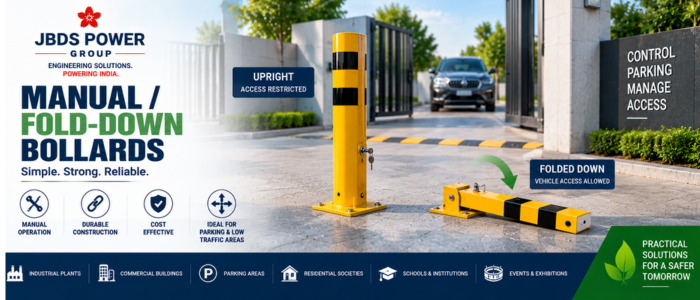
4. Manual / Fold-Down Bollards
Manual bollards can be physically lowered or folded when vehicle access is required.
They provide a relatively simple solution for parking spaces, private properties and locations where automatic operation is not necessary.
5. Security / Heavy-Duty Bollards
Heavy-duty bollards are designed for applications requiring a higher degree of physical vehicle protection.
The engineering specification—including material, dimensions, foundation and impact-performance requirement—should be selected according to the site's security assessment.
Important: A standard bollard should not automatically be described as a crash-rated bollard. Crash-rating claims should only be made where the specific product/system has been tested and certified to the applicable standard.

Automatic Bollard – How Does It Work?
A typical automatic bollard system follows this sequence:
Vehicle Approaches
↓
Access Request / Identification
↓
Authorization
↓
Controller Receives Signal
↓
Bollard Lowers
↓
Vehicle Passes
↓
Safety System Confirms Clearance
↓
Bollard Rises Again
Key Benefits of Bollard Systems
· Enhanced Access Control
Bollards help determine where vehicles can and cannot enter.
· Controlled Vehicle Movement
Automatic systems enable authorized vehicles to pass while maintaining restricted access for others.
· Physical Protection
Properly engineered bollards can help protect building entrances, equipment and designated areas from unwanted vehicle intrusion.
· Flexible Automation
Automatic bollards can be integrated with existing security and access-control infrastructure.
· Space-Efficient Solution
Unlike large gates or barriers, bollards can provide controlled access while occupying relatively little visible space.
· Custom Engineering
Bollard dimensions, finish, operation and control architecture can be selected according to the project.
Where Are Bollard Systems Used?
Bollards can be used across many environments:
Industrial Plants – Gate entry, production areas and restricted zones.
Corporate Offices – Main entrances and controlled parking.
Commercial Buildings – Vehicle access and pedestrian-area protection.
Warehouses & Logistics Parks – Controlled truck and vehicle movement.
Hotels & Premium Properties – Entrance security with architectural integration.
Government Facilities – Controlled entry and perimeter management.
Hospitals – Emergency lanes, restricted areas and parking management.
Residential Societies – Controlled vehicle entry.
Infrastructure Projects – Traffic management and restricted-access zones.
How to Select the Right Bollard System
This is one of the most important parts of a bollard project.
The selection should not be based only on appearance or price.
Before selecting a bollard, consider:
1. Application
Is the requirement primarily for parking control, traffic management, access restriction or higher-security protection?
2. Frequency of Operation
If the bollard needs to operate dozens or hundreds of times per day, an automatic solution may be more appropriate than a manually removable system.
3. Vehicle Type
Passenger cars, commercial vehicles and heavy vehicles can require different engineering considerations.
4. Required Security Level
A normal access-control bollard and a certified impact/crash-rated security bollard are different products.
5. Installation Location
Foundation conditions, underground utilities, drainage, road construction and available installation depth should be evaluated.
6. Control Requirement
Determine whether operation will be through remote control, RFID, access card, security operator, ANPR or another system.
7. Safety Requirement
Automatic systems require vehicle detection & safety sensors to prevent bollard from rising while a vehicle is positioned above it.
8. Environment
Outdoor installations should account for water, dust, corrosion, temperature and drainage conditions.
Bollard System Integration
For larger industrial and commercial projects, a bollard should not necessarily operate independently.
A complete architecture can look like:
ANPR / RFID / Access Card
↓
Access Control System
↓
PLC / Bollard Controller
↓
Automatic Bollard
↓
Loop Detector + Safety Sensor + Traffic Signal
This provides a much more controlled entrance-management system.
Installation Process
At JBDS Power, a bollard project can follow an engineering-led process:
1 .Requirement Discussion
Understand vehicle flow, security requirement and operating conditions.
2 .Site Survey
Review road conditions, available foundation depth, drainage and utilities.
3 . System Selection
Select the appropriate bollard configuration and control method.
4 . Engineering & Manufacturing
Prepare the mechanical, electrical and control solution according to the approved requirement.
5 .Civil & Electrical Preparation
Foundation, drainage, cabling and control infrastructure are prepared.
6 .Installation
Bollard equipment and associated control systems are installed.
7 . Integration & Testing
Access-control commands, sensors and operating sequences are tested.
8 . Commissioning & Support
The completed system is commissioned and handed over with operating guidance.
Why Choose JBDS Power for Bollard Solutions?
JBDS Power provides customized engineering solutions rather than treating every site as the same application.
Our capabilities can cover:
Fixed Bollard Solutions
Automatic Rising Bollards
Removable Bollards
Customized Industrial Bollards
Control Panel Integration
PLC & Automation Integration
Access-Control Integration
Electrical & Mechanical Engineering
Installation & Commissioning
Technical & After-Sales Support
This allows customers to work with a single engineering partner from requirement and design through manufacturing, installation and commissioning.
Looking for a Customized Bollard System?
Whether your requirement is for an industrial plant, corporate entrance, commercial property, parking facility or controlled-access project, JBDS Power can develop a solution according to your site and operational requirements.
Share your site details and application with our engineering team.
JBDS POWER PROJECT INTERNATIONAL PVT. LTD.
📞 7290054361
📧 project@jbdspower.com
🌐 jbdspower.com
📍 Plot No. 302, Sector 7, IMT Manesar, Gurugram, Haryana – 122052
JBDS Power — Engineered Access. Reliable Protection.