
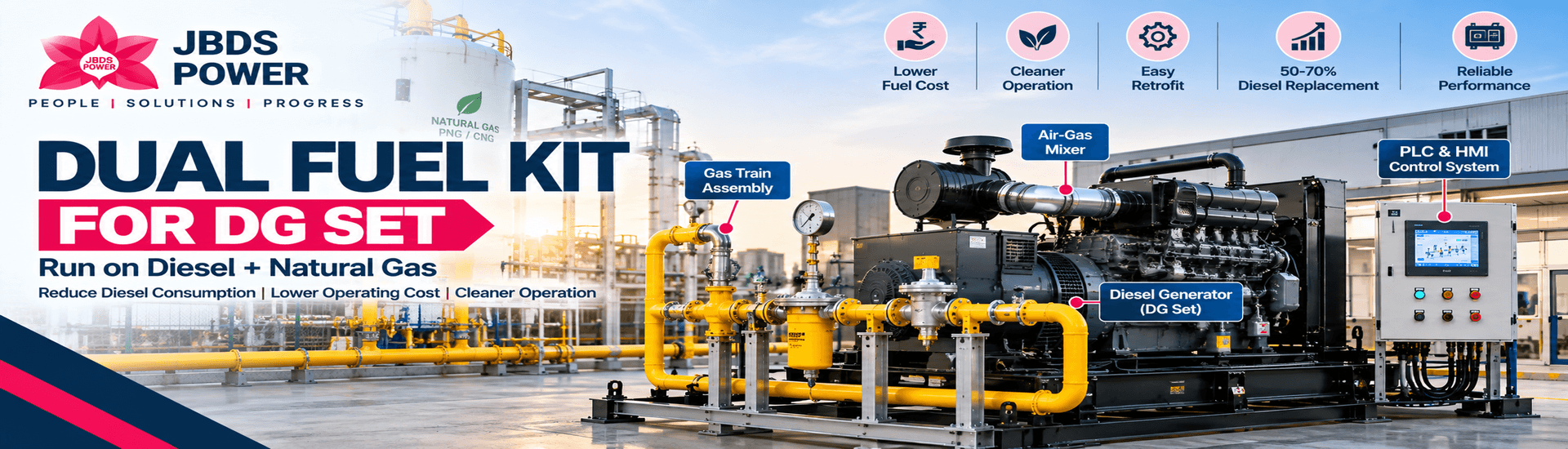
What is a Dual Fuel Kit for a Diesel Generator?
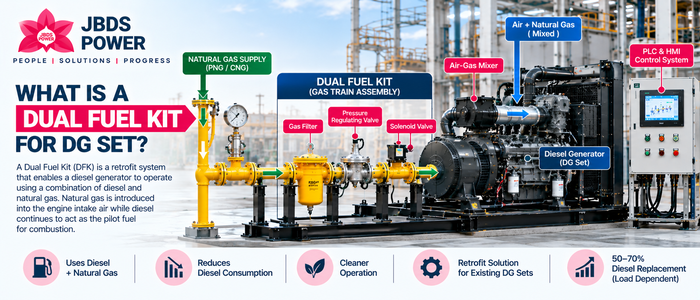
A Dual Fuel Kit (DFK) is a retrofit system designed to enable a diesel generator engine to operate using both diesel and natural gas.
The system introduces a controlled quantity of natural gas into the engine's intake air. The air and gas mixture enters the combustion chamber, where a smaller quantity of diesel acts as the pilot fuel required to initiate combustion.
The basic concept can be represented as:
DIESEL + NATURAL GAS → CONTROLLED COMBUSTION → POWER GENERATION
Unlike a complete engine replacement, a properly engineered Dual Fuel conversion can be integrated with an existing compatible DG set without major changes to the original diesel fuel-injection system.
JBDS Power designs its Dual Fuel solutions for industrial and commercial generator applications where customers want to reduce diesel dependency and utilize available natural gas.
How Does a Dual Fuel Kit Work?
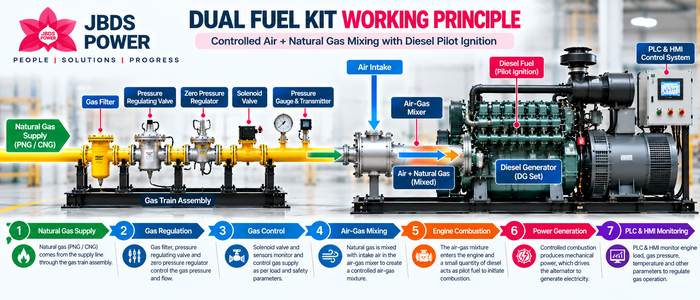
The JBDS Power Dual Fuel system starts the generator in its normal diesel operating mode.
Once the DG engine reaches suitable and stable operating conditions, the control system permits natural gas to enter through the Gas Train Assembly and Air-Gas Mixer.
The operating sequence can be represented as:
DG STARTS ON DIESEL → ENGINE STABILIZES → GAS SUPPLY ENABLED → AIR & GAS MIX → DIESEL PILOT IGNITION → DUAL FUEL OPERATION
During Dual Fuel operation, the control system monitors relevant operating parameters and regulates gas supply according to the generator load and configured operating limits.
Diesel is not completely eliminated. It remains the pilot fuel responsible for initiating combustion of the air-gas mixture.
If operating conditions move outside the programmed limits, an appropriately configured control system can discontinue gas operation and allow the generator to continue in diesel-only mode.
This provides operational flexibility because the DG can retain its conventional diesel mode when natural gas is unavailable or Dual Fuel operating conditions are not satisfied.
Main Components of a Dual Fuel Kit
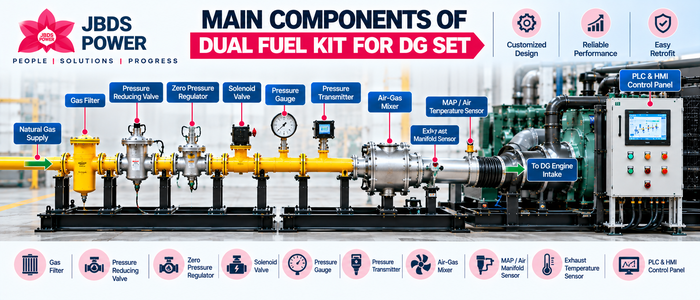
A Dual Fuel conversion system combines gas regulation, air-gas mixing, sensors and electronic control to safely manage natural gas delivery according to generator operating conditions.
The main components can include:
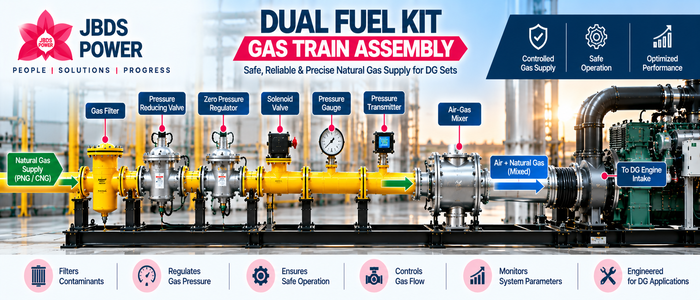
• Gas Filter – Helps remove contaminants from the incoming gas supply.
• Pressure Reducing Valve – Reduces incoming gas pressure to the required operating range.
• Zero Pressure Regulator – Helps regulate gas delivery according to system demand.
• Solenoid Valve – Provides electronically controlled gas ON/OFF functionality.
• Pressure Gauge – Provides local gas-pressure indication.
• Pressure Transmitter – Sends gas-pressure information to the control system.
• Air-Gas Mixer – Mixes natural gas with the engine intake air.
• Fuel Control Valve – Regulates gas flow according to engine operating requirements.
• MAP / Air Manifold Sensor – Monitors relevant intake/manifold conditions.
• Exhaust Temperature Sensor – Monitors exhaust temperature during operation.
• PLC Control Panel – Controls the Dual Fuel operating sequence.
• HMI – Allows operators to monitor system status, parameters and alarms.
The exact scope can vary according to generator configuration and project requirements.
Gas Train Assembly in a Dual Fuel System
The Gas Train Assembly is one of the most important sections of a DG Dual Fuel conversion system.
Its purpose is to receive the natural gas supply, filter it, regulate its pressure and control its delivery before gas reaches the engine intake system.
A typical sequence can be represented as:
GAS SUPPLY → GAS FILTER → PRESSURE REGULATION → SAFETY / SOLENOID VALVE → FLOW CONTROL → AIR-GAS MIXER
The configuration is selected according to available gas pressure, generator capacity and operating requirements.
Pressure regulation and controlled gas delivery are important because an uncontrolled gas supply could affect engine operation. The Dual Fuel system must therefore manage gas flow according to the defined operating parameters.
Role of the Air-Gas Mixer in Dual Fuel Operation
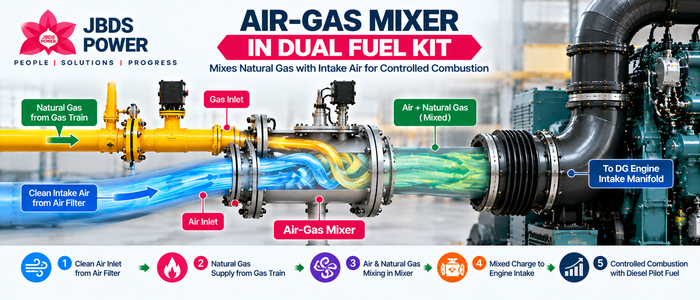
The Air-Gas Mixer introduces natural gas into the engine intake airflow and helps create an appropriate air-gas mixture before it enters the combustion chamber.
Natural gas cannot simply be supplied to the engine at an uncontrolled rate. The quantity needs to correspond with engine airflow, generator loading and the programmed substitution strategy.
The mixer therefore works together with the gas-control components and electronic control system.
Inside the engine:
AIR + NATURAL GAS enter the cylinder → DIESEL is injected as pilot fuel → DIESEL IGNITES → AIR-GAS MIXTURE COMBUSTS → ENGINE PRODUCES POWER
The engineering of the mixer and gas-flow arrangement is therefore an important part of a reliable Dual Fuel conversion.
PLC & HMI Control in a DG Dual Fuel Kit
Modern Dual Fuel systems require more than mechanical gas components. Electronic monitoring and control are important for managing gas substitution under changing generator loads.
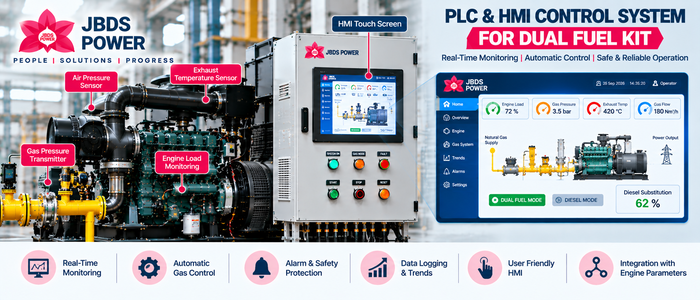
JBDS Power integrates PLC and HMI-based control into its Dual Fuel solutions according to project requirements.
The control system can monitor parameters such as:
• Engine Load
• Gas Pressure
• Exhaust Temperature
• Engine Vibration
• Air / Manifold Conditions
• Gas System Status
• Dual Fuel Operating Status
• Alarm Conditions
The PLC can use these inputs to manage gas flow and determine whether Dual Fuel operation should remain active.
The HMI gives operators a visual interface for monitoring system status, operating parameters and alarms.
If a monitored parameter exceeds its programmed operating limit, the system can be configured to stop gas supply and return the DG to conventional diesel-only operation.
Diesel Replacement with Natural Gas in Dual Fuel Mode
One of the main objectives of a Dual Fuel Kit is to reduce the quantity of diesel consumed by substituting part of the fuel requirement with natural gas.
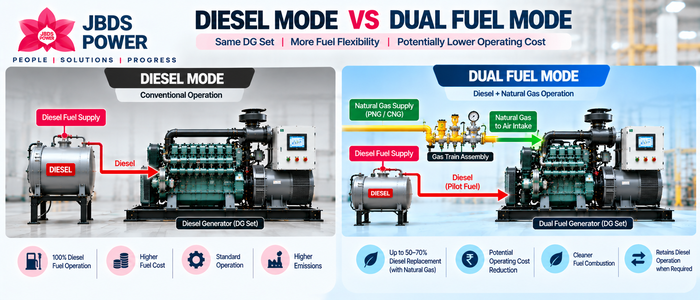
JBDS Power states that, depending on load and operating conditions, its Dual Fuel solution can replace up to approximately 50–70% of diesel with natural gas. Actual substitution should not be treated as a fixed percentage because generator load, engine characteristics, gas quality, operating conditions and system calibration all influence the achievable result.
The generator still requires diesel during Dual Fuel operation because diesel functions as the pilot ignition fuel.
A simplified example is:
Conventional DG: Diesel provides the fuel requirement.
Dual Fuel DG: Diesel pilot fuel + controlled natural gas substitution provide the fuel requirement.
The actual economic benefit therefore depends heavily on the local price difference between diesel and natural gas, generator operating hours and achievable substitution rate.
Key Benefits of a Dual Fuel Kit for DG Sets
A correctly engineered Dual Fuel conversion can provide several operational and commercial benefits where natural gas is available and the generator application is suitable.
• Reduced Diesel Consumption – Part of the diesel requirement can be displaced by natural gas.
• Potential Operating Cost Reduction – Where natural gas has a favorable energy cost compared with diesel, fuel expenditure may be reduced.
• Cleaner Fuel Contribution – Natural gas generally burns more cleanly than diesel and can support reduced dependence on diesel combustion.
• Retains Diesel Operation – The generator can continue to operate in conventional diesel mode when required, subject to the system configuration.
• Automatic Fuel Management – PLC-based controls can regulate gas operation according to monitored parameters.
• Suitable for Existing DG Sets – A Dual Fuel Kit is intended as a retrofit approach for technically compatible diesel generators.
• Reduced Diesel Dependency – Facilities with reliable gas availability can reduce their dependence on diesel-only generation.
• Industrial Automation Integration – PLC, HMI, sensors and monitoring can be integrated into the system.
Actual savings and operating results depend on DG configuration, generator loading, fuel prices, gas quality, operating hours and site conditions.
Dual Fuel Kit vs 100% Diesel Generator Operation
A conventional diesel generator uses diesel as its primary fuel during operation.
A Dual Fuel generator retains diesel but substitutes part of the fuel requirement with natural gas under suitable operating conditions.
Diesel Mode:
Diesel → Engine → Power
Dual Fuel Mode:
Diesel Pilot + Natural Gas → Engine → Power
One major advantage of the retrofit concept is operational flexibility. The DG does not need to depend entirely on natural gas because diesel-only operation remains available according to the engineered system configuration.
This can be valuable for industrial sites where uninterrupted backup-power availability remains the primary requirement.
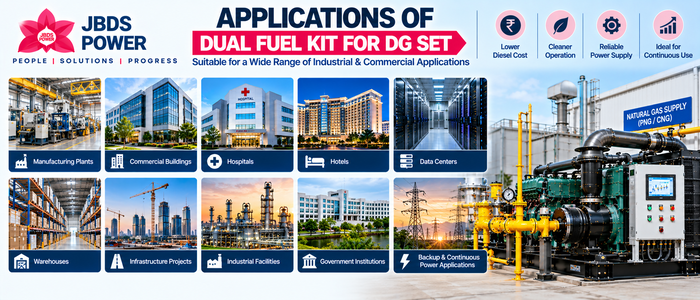
Applications of DG Dual Fuel Kits
Dual Fuel technology can be considered for compatible diesel generators used across industrial and commercial applications where natural gas is available.
Typical applications include:
• Manufacturing Plants
• Industrial Facilities
• Commercial Buildings
• Hospitals
• Hotels
• Data Centers
• Warehouses
• Infrastructure Projects
• Large Commercial Facilities
• Continuous Power Applications
• Backup Power Systems
• Industrial DG Installations
The suitability of Dual Fuel conversion should be evaluated technically for each generator rather than assuming that every DG set can use the same kit configuration.
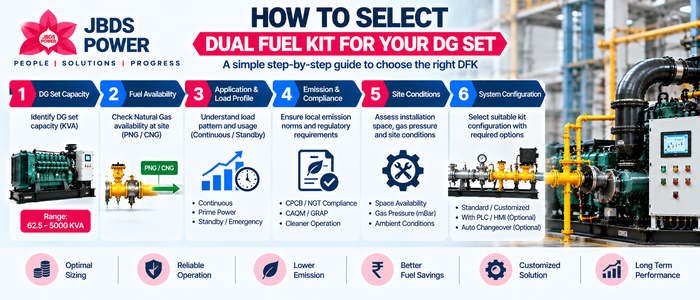
How to Select the Right Dual Fuel Kit for Your DG Set
A Dual Fuel Kit should not be selected only on the basis of generator KVA rating.
Several parameters should be evaluated before designing or selecting the conversion system.
• DG Capacity in KVA
• Engine Make & Model
• Engine Configuration
• Existing Air Intake Arrangement
• Generator Loading Pattern
• Average Operating Load
• Gas Type and Quality
• Available Gas Pressure
• Gas Flow Availability
• Daily DG Operating Hours
• Existing Control System
• Site Layout
• Installation Space
• Safety Requirements
• Required Automation Level
Generator loading is particularly important because the natural-gas substitution strategy changes according to engine operating conditions.
JBDS Power's engineering team can review these parameters before recommending the appropriate Dual Fuel configuration.
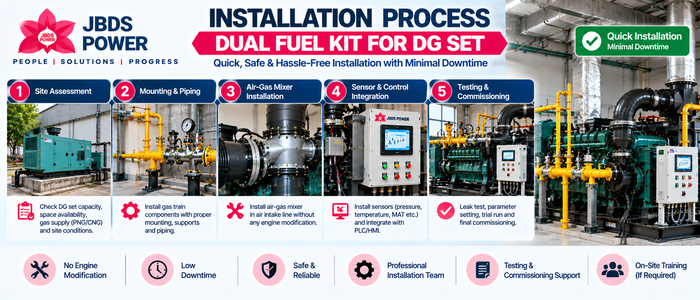
Dual Fuel Kit Installation Process
A structured installation process helps ensure that the Dual Fuel system is correctly matched and integrated with the generator.
A typical JBDS Power project approach can include:
• DG Assessment – Review generator capacity, engine and existing configuration.
• Site Survey – Check installation space, gas availability and site conditions.
• Gas Assessment – Evaluate gas type, pressure and flow availability.
• System Engineering – Select gas train, mixer, controls, sensors and associated components.
• Mechanical Installation – Install gas train and intake-system components.
• Electrical & Control Integration – Connect sensors, PLC, HMI and control components.
• Testing – Verify system operation and monitored parameters.
• Calibration – Configure gas substitution according to engine loading and operating conditions.
• Commissioning – Run and validate the system under appropriate operating conditions.
• Technical Support – Provide operating and maintenance support as required.
The complete sequence can be represented as:
DG ASSESSMENT → SITE SURVEY → ENGINEERING → INSTALLATION → PLC INTEGRATION → TESTING → CALIBRATION → COMMISSIONING
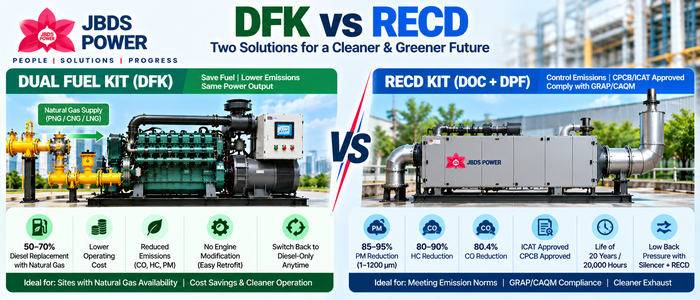
Dual Fuel Kit and RECD Kit – What is the Difference?
A Dual Fuel Kit and an RECD Kit perform different functions and should not be confused.
A Dual Fuel Kit works primarily on the fuel and combustion side of the generator. It allows a portion of diesel consumption to be substituted with natural gas under suitable operating conditions.
An RECD (Retrofit Emission Control Device) works on the exhaust after-treatment side. It is installed in the DG exhaust system and is designed to reduce targeted pollutants in the exhaust after combustion has taken place.
The simplified difference is:
DUAL FUEL KIT → Fuel Management / Diesel Substitution
RECD KIT → Exhaust After-Treatment / Emission Control
Depending on technical requirements and applicable regulations, these technologies may address different objectives in a DG installation.
Customized Dual Fuel Kit Solutions by JBDS Power
Every generator installation has different engine specifications, loading patterns, gas conditions and site requirements.
For this reason, JBDS Power approaches Dual Fuel conversion as an engineered DG solution rather than treating every generator as an identical installation.
The project scope can include:
• Application Study
• DG & Engine Assessment
• Site Survey
• Gas Train Engineering
• Air-Gas Mixer Selection
• Gas Flow Control
• Sensor Integration
• PLC Programming
• HMI Integration
• Electrical Control Panel
• Installation
• Testing & Calibration
• Commissioning
• Technical Support
JBDS Power combines DG-related engineering with industrial automation capabilities, enabling the mechanical gas system and electronic controls to be developed as an integrated solution.
Why Choose JBDS Power for DG Dual Fuel Conversion?
A Dual Fuel project involves more than connecting a natural-gas line to a diesel generator. Gas regulation, air-gas mixing, engine operating conditions, monitoring, control logic and safety must work together as an engineered system.
JBDS Power provides customized Dual Fuel solutions supported by industrial engineering and automation capabilities.
Key capabilities include:
• Customized DG Dual Fuel Engineering
• Gas Train Assembly
• Air-Gas Mixer Integration
• Fuel Control System
• PLC & HMI Automation
• Sensor-Based Monitoring
• Electrical Control Integration
• Installation & Commissioning Support
• Industrial Project Support
• After-Sales Technical Assistance
The objective is to develop a Dual Fuel solution around the customer's actual DG configuration, fuel availability and operating requirement.
Frequently Asked Questions About Dual Fuel Kits
What is a Dual Fuel Kit for a DG set?
A Dual Fuel Kit enables a compatible diesel generator to operate using a controlled combination of diesel and natural gas.
Does a Dual Fuel Kit completely eliminate diesel?
No. Diesel remains necessary as the pilot ignition fuel during Dual Fuel operation.
How much diesel can be replaced by natural gas?
The JBDS Power system is designed for load-dependent substitution that can reach approximately 50–70% under suitable conditions. Actual performance depends on the engine, generator loading, gas conditions and system calibration.
Can the DG operate if natural gas is unavailable?
An appropriately engineered Dual Fuel system retains conventional diesel-only operation, providing fuel flexibility.
Does a Dual Fuel Kit require complete engine replacement?
No. The technology is intended as a retrofit solution for compatible existing diesel generators without requiring complete engine replacement.
Does the system use PLC control?
JBDS Power Dual Fuel systems can incorporate PLC and HMI controls for monitoring, automation and system protection.
What gas is used in a Dual Fuel generator?
Natural gas is commonly used. The exact fuel supply and suitability need to be assessed for the specific installation.
Is a Dual Fuel Kit the same as an RECD Kit?
No. A Dual Fuel Kit manages fuel substitution before combustion, whereas an RECD treats diesel-engine exhaust after combustion.
What details should I provide for a Dual Fuel Kit quotation?
Provide DG KVA, engine make and model, operating load, operating hours, available gas type, gas pressure, installation location and existing DG details.
Looking for a Dual Fuel Kit for Your Diesel Generator?
If your facility operates diesel generators and has access to a suitable natural-gas supply, JBDS Power can evaluate whether a Dual Fuel conversion solution is suitable for your application.
Share the following information with our engineering team:
DG Capacity (KVA) + Engine Make + Engine Model + Average Load + Daily Running Hours + Available Gas Type + Gas Pressure + Installation Location
Our team can evaluate the application and recommend an appropriate system configuration.
JBDS POWER GROUP
Phone: +91 7290054361
Email: digital@jbdspower.com
Email: info@jbdspower.com
Location: Plot No. 302, Sector 7, IMT Manesar, Gurgaon, Haryana – 122052
Contact JBDS Power for customized Dual Fuel Kit engineering, DG conversion, PLC automation, installation and commissioning support.