
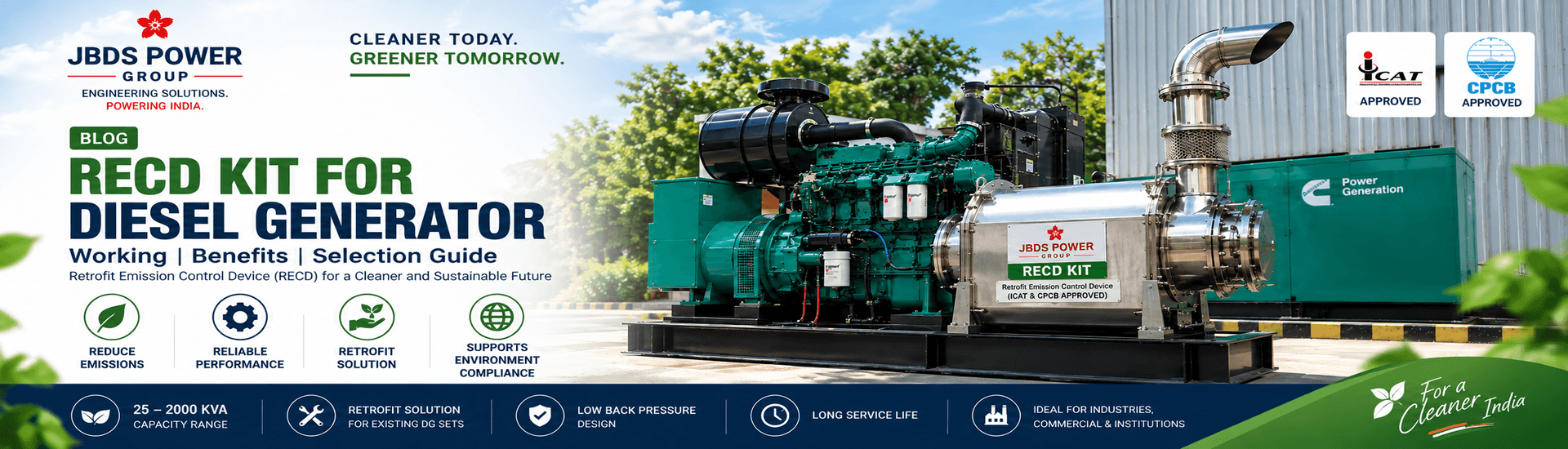
RECD Kit for Diesel Generator: Working, Benefits, Selection And Installation Guide
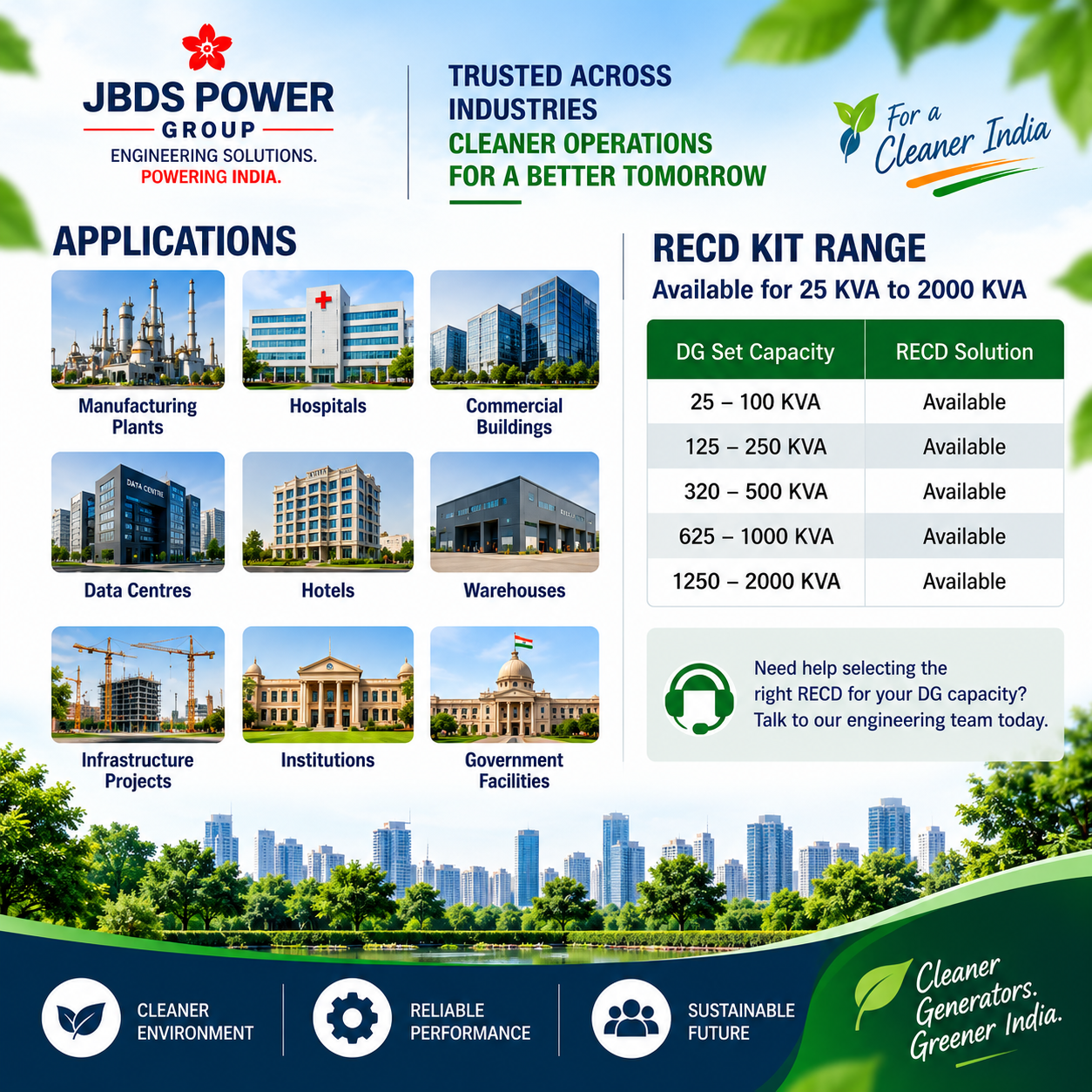
Diesel generator sets are widely used as reliable backup and prime power sources across manufacturing plants, hospitals, commercial buildings, infrastructure projects, warehouses and institutions. However, diesel engines also produce exhaust emissions including particulate matter (PM), carbon monoxide (CO) and hydrocarbons (HC).
A Retrofit Emission Control Device (RECD) is an exhaust after-treatment solution designed to reduce these emissions from existing diesel generator sets.
JBDS Power provides engineered RECD solutions for DG sets across a wide capacity range, with selection based on DG capacity, engine specifications, exhaust parameters, installation conditions and applicable compliance requirements.
What is an RECD Kit?
RECD stands for Retrofit Emission Control Device.
An RECD is an emission-control system installed in the exhaust line of an existing diesel generator. Instead of replacing the DG set, the RECD works as an after-treatment system, treating exhaust gases before they are discharged into the atmosphere.
Depending on the engineered configuration, an RECD can use technologies such as a Diesel Oxidation Catalyst (DOC) and Diesel Particulate Filter (DPF) to address pollutants present in diesel exhaust.
The primary objective is simple:
Existing DG Set → Exhaust Treatment → Reduced Pollutant Emissions → Cleaner Exhaust
For industrial users, an RECD provides a practical approach to improving the emission performance of an existing diesel generator while retaining the existing power-generation equipment.
Why Are RECD Kits Used in Diesel Generators?
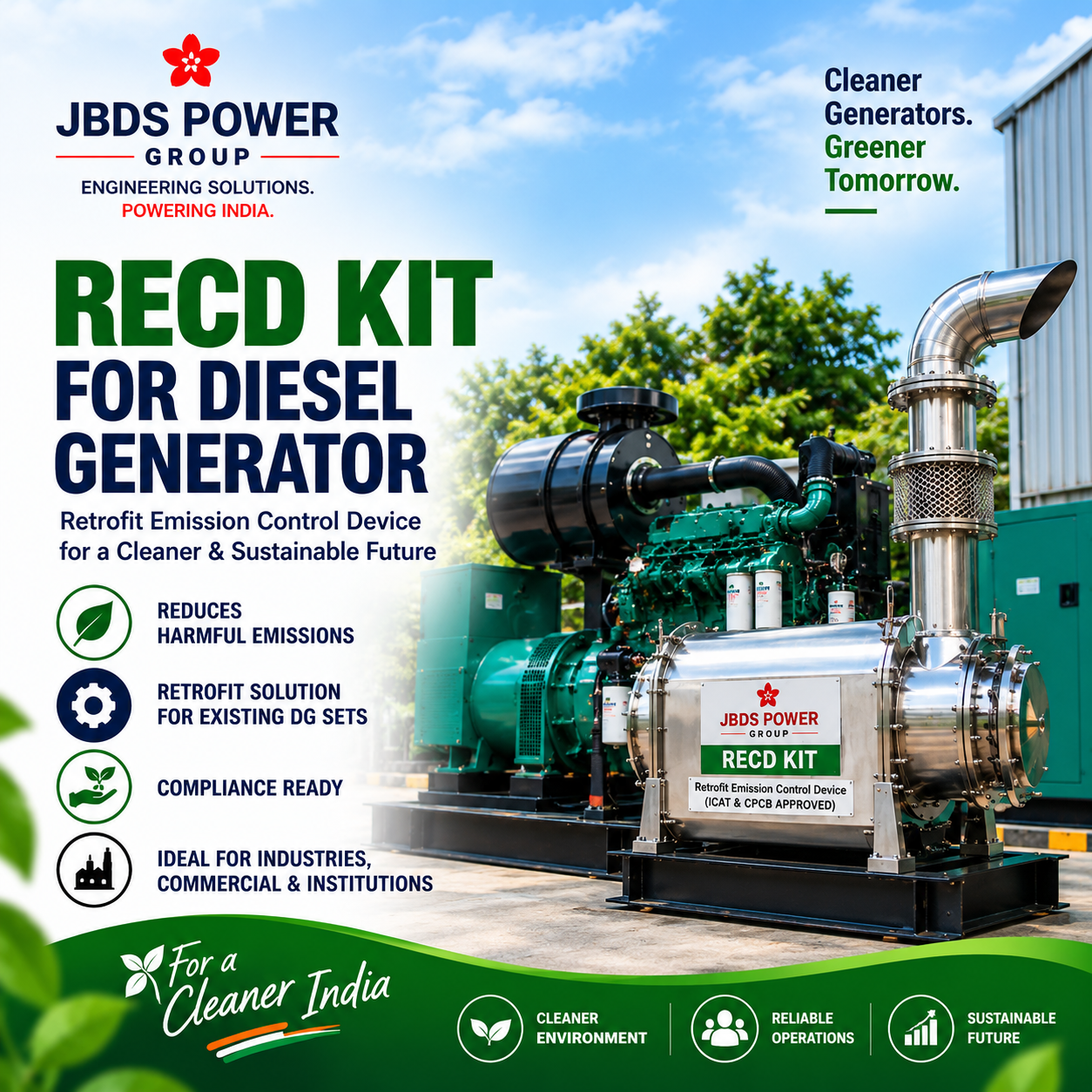
Diesel combustion produces several exhaust constituents. An appropriately designed emission-control system helps reduce targeted pollutants before the exhaust is released.
Particulate Matter (PM)
Particulate matter primarily consists of very small solid and liquid particles generated during diesel combustion. A filtration stage such as a DPF is designed to capture a significant portion of particulate matter present in the exhaust stream.
Carbon Monoxide (CO)
Carbon monoxide can be produced due to incomplete combustion. An oxidation catalyst assists in converting CO into less harmful products through catalytic oxidation.
Hydrocarbons (HC)
Unburnt or partially burnt hydrocarbons may also be present in diesel exhaust. The oxidation catalyst helps oxidize these hydrocarbons under suitable operating conditions.
Environmental Compliance
Emission-control requirements are increasingly important for DG installations across industrial, institutional and commercial facilities. The appropriate RECD configuration should therefore be selected according to the DG set, site conditions and applicable regulatory requirements.
Cleaner Operation of Existing DG Sets
One of the major advantages of a retrofit solution is that the existing generator can continue to be used while an engineered exhaust after-treatment system is integrated with it.
How Does an RECD Kit Work?
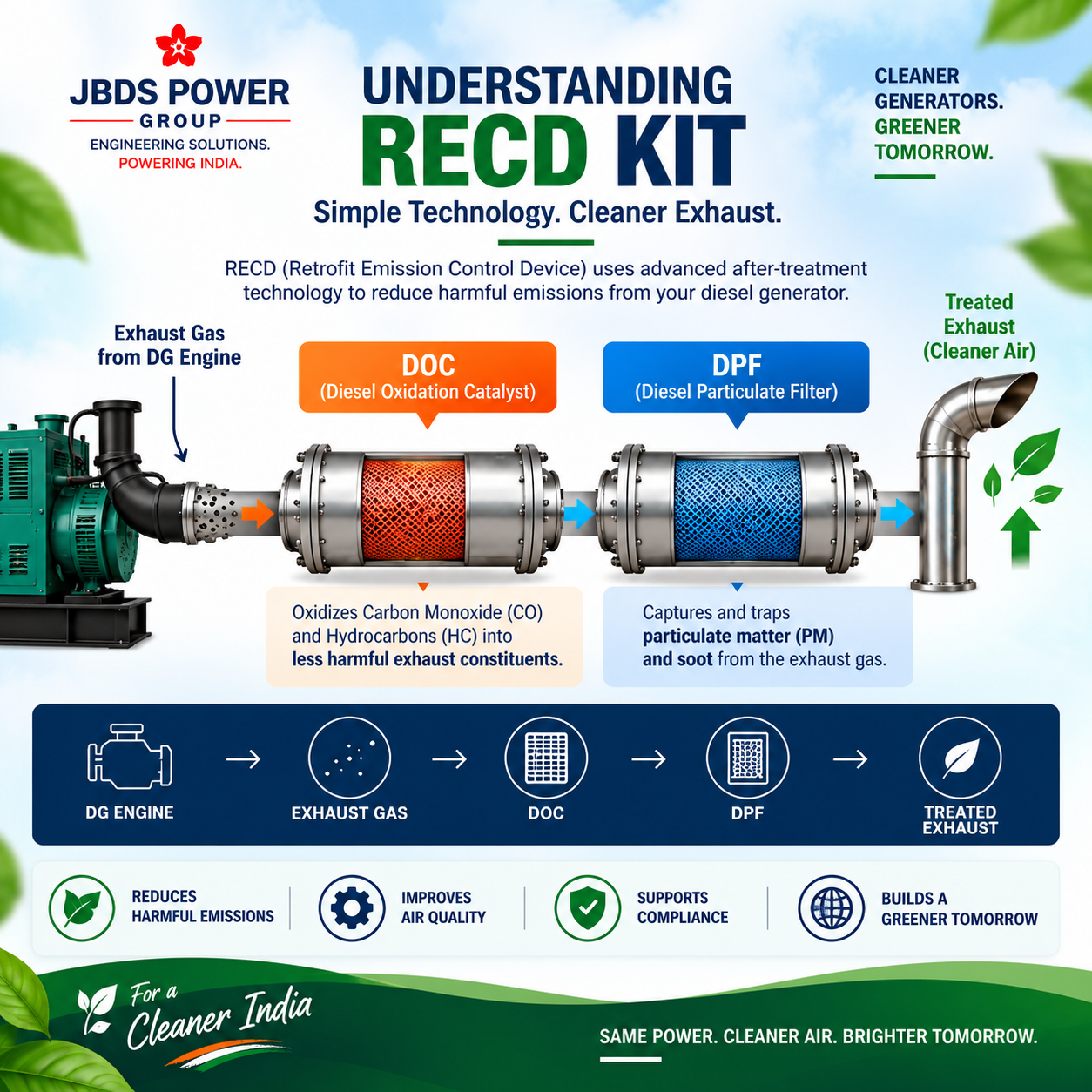
The basic working sequence can be represented as:
DG Engine → Exhaust Gas → DOC → DPF → Treated Exhaust → Outlet
The actual configuration can vary depending on the engine, DG capacity and engineered RECD design.
1. Exhaust Gas Enters the RECD
Exhaust generated by the diesel engine is routed from the DG exhaust outlet into the RECD system.
The RECD is engineered to accommodate the required exhaust flow while keeping permissible back pressure and operating conditions in consideration.
2. DOC – Diesel Oxidation Catalyst
The Diesel Oxidation Catalyst (DOC) is a catalytic after-treatment component.
Under suitable operating temperatures, it promotes oxidation reactions that help convert pollutants such as:
Carbon Monoxide (CO)
and
Hydrocarbons (HC)
into less harmful exhaust constituents.
3. DPF – Diesel Particulate Filter
After the catalytic treatment stage, exhaust passes through the Diesel Particulate Filter (DPF).
The DPF is designed to capture particulate matter and soot present in the diesel exhaust.
4. Treated Exhaust Leaves the System
After passing through the designed treatment stages, the treated exhaust exits through the RECD outlet and is routed to the final exhaust discharge point.
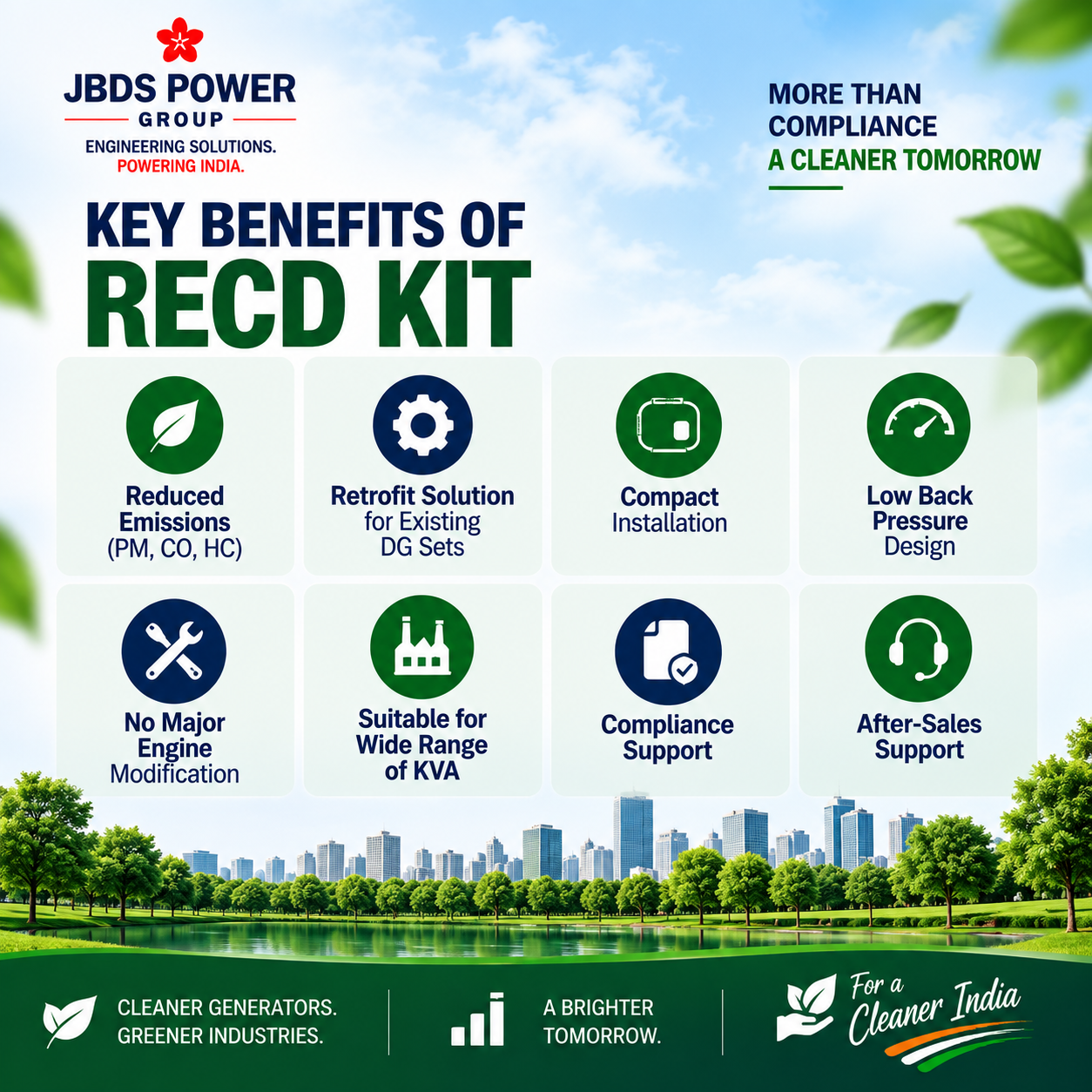
Key Benefits of JBDS Power RECD Solutions
Benefit | What It Means |
|---|---|
Reduced Exhaust Emissions | Designed to reduce targeted pollutants such as PM, CO and HC |
Retrofit Solution | Can be engineered for integration with existing DG sets |
Compact Design | Designed considering available installation space and site conditions |
Low Back Pressure Design | Exhaust system is engineered with permissible back pressure in consideration |
No Major Engine Modification | RECD is integrated primarily with the DG exhaust system |
DG-Specific Engineering | Selection considers DG capacity, engine and exhaust parameters |
Industrial Application | Suitable for a wide range of commercial and industrial DG installations |
Compliance Support | Solution can be selected considering applicable certification and regulatory requirements |
Installation Support | Engineering, installation, testing and commissioning support available |
After-Sales Support | Technical and maintenance support for installed systems |
JBDS Power RECD Kit Range – 25 KVA to 2000 KVA
JBDS Power offers RECD solutions for diesel generators across a broad capacity range.
DG Set Capacity | RECD Solution |
|---|---|
25–100 KVA | Available |
125–250 KVA | Available |
320–500 KVA | Available |
625–1000 KVA | Available |
1250–2000 KVA | Available |
The above table represents the general capacity range. Final RECD selection should not be based only on the DG's KVA rating.
Engine make/model, exhaust parameters and installation conditions should also be evaluated before finalizing the system.
Not sure which RECD is suitable for your DG?
Share the following information with the JBDS Power engineering team:
DG Capacity (KVA) + Engine Make + Engine Model + Installation Location + Existing Exhaust Arrangement
This allows the technical team to evaluate the appropriate configuration.
RECD Kit Installation Process
A properly engineered installation is important for both emission-control performance and DG operation.
JBDS Power follows a structured project approach:
1 . Site Survey
The existing DG installation, exhaust routing, available space and site conditions are reviewed.
2. DG & Engine Assessment
DG capacity, engine make/model and relevant technical parameters are evaluated.
3 . RECD Selection
A suitable RECD configuration is selected based on the technical assessment and applicable requirements.
4 .Engineering
Exhaust routing, mounting arrangement, connections, structural support and other installation requirements are planned.
5 .Installation
The RECD is integrated with the existing DG exhaust system according to the approved installation arrangement.
6 .Testing
The installed system and DG operating parameters are checked.
7 .Commissioning
After satisfactory testing, the system is commissioned for operation.
8 .Technical Support
Maintenance and technical support can be provided for continued operation of the system.
SITE SURVEY → DG ASSESSMENT → RECD SELECTION → ENGINEERING → INSTALLATION → TESTING → COMMISSIONING → SUPPORT
How to Select the Right RECD Kit for a Diesel Generator?
Selecting an RECD only by saying “I have a 500 KVA DG” is not always sufficient.
Several technical parameters should be considered.
Selection Parameter | Why It Matters |
|---|---|
DG KVA Rating | Establishes the basic generator capacity |
Engine Make & Model | Different engines can have different exhaust characteristics |
Exhaust Flow | Important for sizing and internal flow design |
Exhaust Temperature | Catalyst and filtration performance are temperature-dependent |
Existing Silencer Arrangement | Determines how the RECD can be integrated |
Available Space | Influences mounting position and exhaust routing |
Permissible Back Pressure | Important for maintaining proper engine operation |
DG Loading Pattern | Operating load influences exhaust conditions |
Site Conditions | Indoor/outdoor installation and surrounding conditions affect engineering |
Compliance Requirement | Applicable requirements need to be established before selection |
Why this matters
An incorrectly sized emission-control device can create unnecessary exhaust restriction or may not operate under the conditions for which it was designed.
Therefore, application-specific engineering is preferable to selecting an RECD solely by KVA capacity.
Why Choose JBDS Power for RECD Solutions?
An RECD project involves more than supplying an emission-control device. Proper selection, engineering and installation are equally important.
JBDS Power provides an end-to-end approach:
Engineering & Manufacturing Capability
RECD systems are developed around industrial DG applications and project requirements.
DG-Specific Selection
Solutions can be selected considering generator capacity, engine configuration and exhaust characteristics.
Wide Capacity Range
RECD solutions are available across 25 KVA to 2000 KVA DG applications.
Installation & Commissioning
JBDS Power can support site engineering, installation, testing and commissioning.
Technical Support
Our engineering team assists with product selection and application-related technical requirements.
Industrial Project Experience
RECD systems have been deployed across different DG brands, capacities and industrial operating environments.
After-Sales Support
Technical assistance and maintenance support are available for installed RECD systems.